
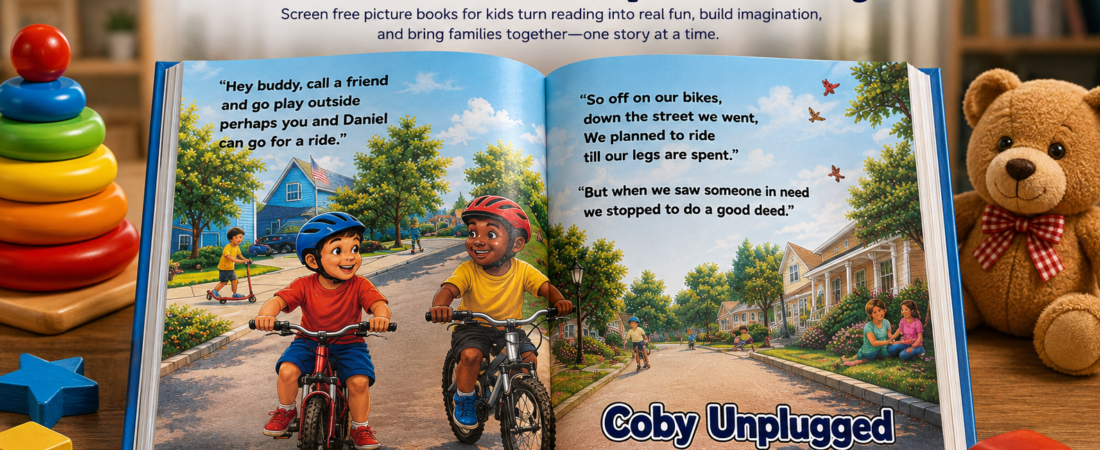
Screen free picture books for kids are illustrated stories that champion offline curiosity, hands-on exploration, and inventive play over digital entertainment. These books show young characters discovering that everyday toys, backyards, and cardboard boxes offer far richer adventures than glowing monitors or handheld games. By handing children a physical book, parents give them a tangible alternative to passive media that immediately sparks independent make-believe.
Finding great screen free picture books for kids matters because today’s entertainment environments are designed to capture attention and hold it indefinitely. When young children spend hours watching quick-cut videos or tapping bright icons, self-directed creativity often takes a back seat. Illustrated stories reverse that flow by inviting children to supply their own sound effects, project their own emotions, and extend the narrative into the living room once the final page closes.
A well-crafted picture book does not merely lecture children about putting down an electronic device. Instead, it invites them into bright, playful worlds where building a fort, exploring a shoreline, or hosting a neighborhood gathering becomes the highlight of the week. These stories rekindle a child’s natural desire to make things, wander outside, and share adventures with family and friends.
Key Takeaways
- Screen free picture books for kids highlight character-driven fun without glowing displays, making real-world play feel exciting and inviting.
- Reading physical paperbacks strengthens parent-child bonds, encourages independent imagination, and supports healthy daily routines.
- Stories focusing on outdoor adventures, power blackouts, and unplugged afternoons give young readers concrete ideas for offline play.
- Making physical books central to daily routines helps families establish balanced media habits without daily power struggles.
Comparing Top Picture Books for Unplugged Fun
The following table compares standout titles that inspire children to put aside devices and jump into creative play. Each book offers a unique storyline, an age-appropriate focus, and a direct prompt for off-screen activities.
| Book Title | Recommended Age | Main Theme | Hands-On Activity Sparked | Format & Price |
|---|---|---|---|---|
| Coby Unplugged by Ken Frank | Ages 4 to 9 | Stepping away from devices to explore backyard fun | Backyard games, creative drawing, and fort building | Paperback, $12.95 at Books.by |
| Doug Unplugged by Dan Yaccarino | Ages 3 to 7 | A small robot learning that real experience beats data downloads | Neighborhood walks, sensory scavenger hunts | Hardcover / Paperback |
| Blackout by John Rocco | Ages 4 to 8 | A city family rediscovering each other during a power outage | Shadow puppets, flashlight games, and board games | Hardcover / Paperback |
| When Charlie McButton Lost Power by Suzanne Collins | Ages 4 to 9 | A tech-obsessed boy finding imaginative games with his sister | Cardboard construction and sibling role-play | Hardcover / Paperback |
| Coby’s Cape Cod Vacation: Part One by Ken Frank | Ages 4 to 9 | Coastal exploration and family adventure | Beachcombing, sandcastle architecture, nature walks | Paperback, $12.95 at Books.by |
| Coby’s Summer Party by Ken Frank | Ages 4 to 9 | Cooperative party planning and outdoor hospitality | Yard games, homemade decorations, group play | Paperback, $12.95 at Books.by |
Why Screen Free Picture Books for Kids Inspire Real World Fun
Children learn how to view their surroundings by watching what happens to the characters in their favorite stories. When a character in a book turns off a gadget and discovers a treehouse or a cardboard rocket, the young reader internalizes that play does not require electricity. The colorful pages of screen free picture books for kids provide a welcoming entry point into independent play, helping young minds realize that an afternoon without screens is an open door rather than a chore.
Current statistics show why this gentle alternative is so necessary. A 2025 survey by Pew Research Center found that 90% of U.S. parents of children ages 12 and younger say their child ever watches TV, 68% say they use a tablet, and 61% say they use a smartphone. With mobile media everywhere, young children easily default to passive watching whenever quiet moments arise. Physical books disrupt that automatic habit by offering an engaging, tactile experience that requires active mental participation.
Health and pediatric organizations continually stress the importance of preserving childhood play. Early childhood guidance from the World Health Organization recommends that children ages 2 to 4 spend no more than 1 hour of sedentary screen time per day. Similarly, Mayo Clinic guidance recommends limiting screen time to one hour a day of high-quality programming for children ages 2 to 5. Reading screen free picture books for kids fits naturally within these recommendations, giving families an easy way to replace digital media with physical storytelling.
       [Screen Media]                 [Physical Picture Book]
              │                                   │
      Passive Attention                   Active Imagination
              │                                   │
       Sedentary Posture                   Tactile Engagement
              │                                   │
      App-Driven Stimulus                 Reader-Led Discovery
When children regularly see books in their home, their relationship with literacy flourishes before school even begins. Yet maintaining this enthusiasm requires ongoing attention. The Scholastic Kids & Family Reading Report 8th Edition found that children’s reading books for fun and positive sentiment toward reading show marked declines by age 9 that do not rebound. Introducing bright, playful books for children between ages 4 and 9 keeps reading enjoyable and protects that critical window of enthusiasm.
Physical picture books also create a calm, peaceful atmosphere that digital media cannot duplicate. When an adult opens a book with a child, eye contact, tone of voice, and gentle page turns regulate the nervous system. The child sets the reading pace, lingering on a detailed illustration or turning back to revisit a favorite scene. That quiet, unhurried focus is the foundation upon which imaginative play is built.
What is Screen-Free Week?
Screen-Free Week is an international annual initiative that invites children, families, schools, and communities to turn off entertainment screens and celebrate the pleasures of the physical world. For seven full days, participants set aside televisions, tablets, gaming consoles, and smartphones in order to rediscover hobbies, outdoor play, shared reading, and face-to-face social time.
Originally launched in the 1990s as TV-Turnoff Week, this global event has adapted to address the rise of portable devices and streaming services. Families who participate do not have to abandon work computers or school assignments. Instead, they pause leisure-based screen time, swapping digital entertainment for library visits, board games, bicycle rides, and backyard sports.
Taking part in the event gives families a low-pressure framework to assess their habits. Many parents discover that when handheld entertainment disappears, their kids initially complain of boredom for an hour or two, only to quickly invent intricate fantasy games, write their own stories, or pull forgotten craft supplies out of storage. Screen free picture books for kids serve as wonderful companion tools during this week, giving young children comforting narratives about stepping away from screens and finding joy in everyday surroundings.
Bright Picture Books That Show the Outside World Beyond Screen Habits
The most effective picture books do not scold children for loving electronic entertainment. Instead, they acknowledge the magnetic pull of glowing devices while demonstrating that the outside world beyond screen habits is larger, richer, and full of genuine surprises. The following titles approach screen-free living with humor, warmth, and vibrant artistry.
Coby Unplugged by Ken Frank
In Coby Unplugged, author and illustrator Ken Frank tells the story of an enthusiastic pup named Coby who finds himself glued to a glowing monitor on a sunny afternoon. When the device is put away, Coby wanders outdoors and discovers that his neighborhood holds far more excitement than any digital game could offer. The book uses colorful, expressive illustrations and upbeat prose to show young readers how easy it is to trade buttons and monitors for running, jumping, and creative make-believe.
Families can order the paperback edition of Coby Unplugged for $12.95 at Books.by. Because the book speaks directly to kids ages 4 to 9, it serves as a non-judgmental prompt for household conversations about media use. Children see themselves in Coby’s initial hesitation, and they share in his excitement as he turns simple outdoor moments into grand adventures.
Doug Unplugged by Dan Yaccarino
Dan Yaccarino’s Doug Unplugged introduces readers to a friendly robot whose parents plug him into a computer port every morning to download facts about history, science, and geography. One day, Doug spots a tiny pigeon outside the window, unplugs his connection cable, and slips out into the city streets. As Doug wanders through the neighborhood, he discovers that knowing facts about a city is entirely different from smelling bakery bread, feeling wet cement, or high-fiving a new friend.
Doug Unplugged illustrates the concept that hands-on reality offers sensory depth that data downloads simply cannot replicate. Young readers love seeing the contrast between Doug’s structured digital world and the messy, joyous details of the sidewalk. The story reminds children that true learning happens through active, physical participation with the environment around them.
Blackout by John Rocco
John Rocco’s award-winning book Blackout captures the sudden shift that occurs when normal electrical power cuts out across a bustling city neighborhood. A young boy tries to coax his busy family members away from phone calls, desktop computers, and video games, but everyone is too distracted. When an unexpected blackout plunges the entire apartment into darkness, the gadgets shut down, candles are lit, and the family gathers on the living room floor to play shadow puppets and talk.
The narrative shifts dynamically from small, dark comic panels to expansive, luminous rooftop spreads as the entire neighborhood ventures outside to look at the night sky. Rocco portrays the power outage not as an inconvenience, but as an unexpected gift that brings a disconnected community together. Children learn that when technology sleeps, human connection comes alive.
When Charlie McButton Lost Power by Suzanne Collins
In When Charlie McButton Lost Power, written in lively rhyme by Suzanne Collins and illustrated by Mike Lester, young Charlie McButton is a tech-obsessed boy who lives for computer games and handheld controllers. When a sudden thunderstorm causes a power blackout in his house, Charlie panics and searches frantically for spare batteries. In his desperation, he tries to pull a battery from his little sister’s toy, leading to a brief squabble and a quiet timeout.
Sitting quietly without any working gadgets, Charlie begins to notice his sister’s imagination at work. The two siblings team up, transforming an empty room into an imaginary kingdom filled with clay monsters and cardboard castles. The rhyming text keeps the mood lighthearted while teaching kids that sibling cooperation beats any single-player console.
“A great picture book does not merely replace a screen for twenty minutes; it plants an idea in a child’s mind that blooms across the entire living room floor after the book is closed.”
Stories That Turn Screen Time Into Outdoor Adventures
Imaginative play flourishes when children step beyond indoor walls and explore the natural world. Picture books that emphasize outdoor exploration give children practical inspiration for what to do once they step into the yard, a park, or a sandy beach.
Ken Frank’s Coby’s Cape Cod Vacation: Part One and Coby’s Cape Cod Vacation: Part Two transport young readers straight into the coastal outdoors. Coby spends his days chasing waves, inspecting tide pools, collecting sea glass, and discovering marine life along the shore. Both paperbacks are available for $12.95 each at Books.by. By following Coby’s journeys, young children learn to look closely at rocks, shells, and footprints, turning a simple family walk into an archaeological investigation.
In Coby’s Summer Party, also available in paperback for $12.95 at Books.by, Coby turns his attention to community and friendship. The story focuses on organizing an outdoor gathering, setting up lawn activities, and sharing treats with neighbors under the summer sun. Stories like this provide models for social development, showing how group games, shared chores, and open-air celebrations build lasting friendships without a single gadget involved.
Connecting picture books to nature also counteracts what researchers call nature deficit disorder, a term popularized to describe the behavioral and developmental costs of spending childhood entirely indoors. Data from the National Survey of Children’s Health analyzed by researchers at the CDC Stacks revealed that 37% of children aged 3 to 5 years played outdoors for 1 hour or less on weekdays. When picture books depict characters hiking through coastal dunes, running across grass, or hosting backyard gatherings, they reawaken a child’s eagerness to run outside and explore.
┌────────────────────────────────────────────────────────┐
│             The Outdoor Adventure Loop                 │
│                                                        │
│  1. Read an outdoor picture book together              │
│  2. Step into the yard or local park                   │
│  3. Recreate story elements with sticks and stones     │
│  4. Return inside energized and ready for quiet play   │
└────────────────────────────────────────────────────────┘
When children immerse themselves in outdoor stories, they build vital physical strength and coordination. Running through grass, digging in sandy shores, and balancing across fallen logs develop core motor abilities that sedentary entertainment ignores. Furthermore, outdoor pretend play fosters cooperative social skills, as children negotiate the rules of their imaginary games, take turns leading, and adapt to shifting physical environments.
How Families Can Unplug With These Book Selections Daily
Adopting a balanced routine does not mean parents must permanently ban every electronic device or throw away household gadgets. It means intentionally curating an environment where physical books, craft supplies, and open-ended toys are within arm’s reach, while digital entertainment stays out of sight until designated hours. Parents can easily implement practical steps to weave screen free picture books for kids into their daily household rhythm.
Establish a Protected Read Aloud Time
Designate at least twenty minutes every afternoon or evening as dedicated read aloud time. Turn off the television, place smartphones in a charging basket in another room, and sit together on a comfortable sofa or rug. Let the child select two or three picture books from a low shelf where titles are displayed cover-forward. Reading aloud together establishes a consistent harbor of calm where conversation, laughter, and questions flow freely.
Create Themed Play Stations Inspired by Stories
After finishing a story, leave props nearby that mirror the narrative. If the family just read Coby Unplugged, set out sidewalk chalk, cardboard boxes, and tennis balls on the patio. If the story centered on coastal exploration, place a plastic tub of water, smooth stones, and plastic sea creatures on the kitchen table. Children transition effortlessly from listening to creating when tangible materials are placed directly before them.
Cultivate a Digital Minimalist Home Rhythm
Many parents find inspiration in adopting a digital minimalist approach to childhood spaces. Keep bedrooms and play areas entirely free of monitors, gaming setups, or mobile chargers. When the primary rooms of the house feature baskets of picture books, wooden blocks, sketch pads, and costumes, children turn to those resources instinctively whenever they look for something fun to do.
Maintaining this balance is an ongoing family practice rather than a one-time fix. Managing screens often feels like an art form, where parents continually assess their child’s mood, energy levels, and school demands. When parents notice irritability or glazed expressions after video watching, trading digital entertainment for a stack of picture books resets the emotional climate of the home.
┌─────────────────────────────────────────────────────────────────┐
│                    Daily Screen-Free Play Log                   │
├───────────────────┬────────────────────────┬────────────────────┤
│ Time Block        │ Suggested Book Pairing │ Creative Activity  │
├───────────────────┼────────────────────────┼────────────────────┤
│ Morning Play      │ *Doug Unplugged*       │ Sensory Walk       │
│ Quiet Midday      │ *Coby Unplugged*       │ Fort Building      │
│ Afternoon Fun     │ *Coby's Summer Party*  │ Backyard Games     │
│ Bedtime Wind-Down │ *Blackout*             │ Shadow Puppets     │
└───────────────────┴────────────────────────┴────────────────────┘
The long-term benefits of this habit stretch far into adolescence. The 2026 Common Sense Media Census found that a typical tween spends about five hours a day with screen media for entertainment, according to research published by Common Sense Media. Establishing a deep, loving relationship with physical picture books during the elementary years protects children from drifting into excessive media habits as they grow older.
Kid/Teen Recommendations
As children transition from early childhood into upper elementary and the teen years, their media habits shift dramatically toward personal smartphones, gaming consoles, and social media feeds. According to a 2024 CDC data brief, 50.4% of U.S. teenagers ages 12 to 17 had 4 hours or more of daily screen time during July 2021 through December 2023, as reported by the Centers for Disease Control and Prevention. Moving beyond screen free picture books for kids means offering older readers print alternatives that respect their independence while encouraging healthy offline habits.
For middle-grade readers and young teens, graphic novels, outdoor survival handbooks, and hands-on maker guides provide an engaging path away from the glowing screen. Novels featuring young protagonists who solve mysteries without cell phones, hike backwoods trails, or build backyard projects reignite a sense of physical adventure. Handing a tween a tactile field guide, a sketchbook, or an immersive fantasy paperback reminds them that deep entertainment exists outside algorithmic notifications.
Adult Recommendations
Children learn screen habits primarily by watching the adults around them. When parents routinely put down an iPad or smartphone to pick up a physical paperback, children naturally treat reading as a desirable daily pleasure rather than a chore. To establish a genuinely unplugged household atmosphere, adults also benefit from reading books that examine modern media habits and celebrate offline living.
Non-fiction works on digital minimalism, outdoor skills, and family storytelling give grown-ups practical frameworks for reclaiming their evenings from endless feeds. Reading these guides helps parents set firm boundaries around household technology, plan weekend camping trips, and rediscover the joy of quiet personal hobbies. When parents model screen-free leisure, sharing screen free picture books for kids becomes an authentic family lifestyle rather than a set of rules enforced only on the youngest members of the house.
Frequently Asked Questions
Need a Printable Copy of this Book List?
You can easily copy this reading list or bookmark the collection at cobysadventuresbooks.com for quick reference during your next library visit or bookstore trip. Keeping a physical list of screen free picture books for kids on the refrigerator helps parents and babysitters choose engaging titles whenever quiet time approaches.
How do picture books help reduce screen time?
Picture books reduce screen time by offering an appealing, tactile alternative that engages a child’s imagination without overstimulating their nervous system. When young readers explore vibrant illustrations and relatable characters on physical pages, they naturally transition into creative pretend play rather than asking for another video.
What age group benefits most from screen free stories?
Children ages 4 to 9 experience immense cognitive and social benefits from screen free stories because this developmental window is when imaginative play and independent reading habits take root. Picture books like Coby Unplugged provide clear models for creative problem solving that children can immediately test in their own playrooms.
Can a picture book compete with an iPad or tablet?
A picture book easily competes with an iPad or tablet when parents make shared reading an affectionate, engaging daily routine. While a digital screen provides fast sensory stimulation, a physical book offers warm human connection, reader-controlled pacing, and an open runway for real-world games that last long after storytime ends.
Choosing Real Play Over Daily Screens
Parents who take active steps to introduce screen free picture books for kids give their children the gift of a rich, self-directed imagination. When children spend their afternoons turning physical pages, exploring neighborhood parks, and inventing imaginary worlds with siblings, they build resilience, focus, and social confidence. These foundational childhood experiences cannot be downloaded from an app store or streamed through a subscription service.
If families do nothing to intervene, digital media will steadily fill every quiet hour of the day. Passive watching displaces tree climbing, fort building, and the quiet joy of getting lost in a good book. By stocking home shelves with bright, playful paperbacks, parents protect their children’s right to wander, create, and experience childhood at its natural, joyful pace.